How to Port Your Health Insurance Policy Without Losing Benefits
Why Porting Your Health Insurance Matters
Are you stuck with your current health policy? Maybe the service is poor. Or the premiums are too high. So you want to port your health insurance policy with a new company. But you are afraid. You are concerned about losing all of your hard-earned benefits. This is a very common fear for many people.
You have been with your insurer for years. The waiting periods were served by you. You have received your No-Claim Bonus (NCB). Starting all over again from scratch is a massive loss to you. It feels unfair. You may think it’s better than to be unhappy than it is to lose benefits.
This is when portability comes in. However, it is your right as a policyholder. You can transfer health insurance to another company. You do not need to start off from scratch. The process is designed to offer protection to you. It allows you to change your providers with ease.
But there is a catch. You must follow the rules. It takes only one small mistake and you get in trouble. You might lose the very benefits you have tried to guard. This is the guide here to stop that from happening. We are going to go through each and every step.
We will teach you how to port your policy. So you will learn to keep your waiting periods. You will protect your No-Claim Bonus. This guide makes sure that you make this switch without losing your advantages. In this sense, you will be able to move with confidence.
Understanding Health Insurance Portability
What Exactly is Portability?
Health insurance portability is a simple concept. It allows you to change your policy. You can switch from one insurance company to another. You can even change plans under the same insurer. It is like switching your mobile number provider. You keep your number.
Here, you keep your benefits. The main theme of the portability is “continuity.” Just for the time that you already spent you get credit for it. Your new insurance company needs to respect the fact you worked for and needs to respect your earned benefits. This is not a favor. It is a right.
This right gives you, the customer, the power. It forces insurance companies to compete. They must offer good service. They must offer fair pricing. If they do not, you can leave. You can carry your business elsewhere.
Compare the Group Health Insurance vs Individual Policy — Key Differences to find what suits you best. Also, learn How Pre-Existing Diseases Affect Health Insurance Premiums and explore Understanding No-Claim Bonus in Health Insurance to maximize your savings.
Why Did IRDAI Introduce This?
The IRDAI portability guidelines qualify to be a game-changer. IRDAI is the Insurance Regulatory and Developing Authority of India. To your protection they made these rules. Portability Before, you were trapped. You were stuck with your insurer.
This old system was bad for customers. Insurers had no reason to get better. They knew you would not leave. To leave meant to start all over. You would be faced with new waiting periods. You would lose the protection of your no-claim bonus protection.
IRDAI saw this problem. They made portability available. This move shifted the power. Over was the power taken out of your hands. It requires insurers to make you loyal to them. They must offer good service. If they fail you can port your health insurance policy.
The Core Benefits You Get to Keep
So, what benefits do you keep? There are two main pillars. These are the most valuable parts of your policy. You have put up your hard work to gain them. Portability protects them.
First is what is known as your No-Claim Bonus (NCB). This is a reward for making none of the claims. It may often mean a discount on your next premium. Or it could be an increased sum insured. This bonus is yours. You take it with you.
Second, and most important, are waiting periods. Well, you are given credit for the time that you served. This includes the waiting period for pre-existing diseases. It also covers time-bound exclusions. It is not necessary to reset the clock. This is the greatest victory of portability.
Are You Eligible to Port Your Policy?
Porting sounds great. But not everyone can do it. You have to go through specific conditions. These rules are not complex. But they are strict. Some benefits, to be fair, are complex, which is why nowadays you have a site, for example, that checks if you’re eligible for a benefit.
You need to make sure that you read these rules carefully. We get missing out one can stop your application. We would like your porting process to be incorrect. So, let’s take a look at some rules which you don’t have to lead anywhere.
The Non-Negotiable Rules
Think of these as being the entry ticket. You need to have these in order to get in line. They are simple. They are logical. Fairness of the system is provided by them.
Rule 1: Policy Type
Well, on you have to port to a similar policy. The rule is “like-to-like.” You can retail health policy portability. You can shift it to some other retail health policy. This is the most common path.
It’s generally not possible to port a group policy. A group plan provided by your employer is different. It has different rules. Porting it down to a personal plan is complicated. Some insurers provide migration and not porting. Check with the insurance company of your employer first.
Rule 2: Continuous Renewal
And this is the most important rule. Your policy must be active. You need to have renewed it with no breaks. Having a gap of one day can void your portability. This is why you should never miss a renewal date.
Switching health insurance providers requires clean record. It illustrates that you are a responsible policyholder. Insurers view this as a good thing. Always remind yourself about your renewal. Don’t forget or miss your premium date – every time. This leaves all your options open.
Rule 3: The Timeline
You can’t wake up on renewal day and port. The process takes time. Your new insurance company needs to review your case. You have to apply well in advance. We will touch on this precise timeline sooner rather than later.
The key is planning. Please do not wait right down to the last minute. This is the biggest mistake that people make. Start the process early. Give the new company time to work. This is in order to make for a smooth transition.
Common Myths about Eligibility
Many myths prevent people from porting. Let’s clear the air. Such misconceptions can cost you a better policy.
One myth that exists is that: “You can’t port if you made a claim.” This is false. You most certainly can port after a claim. It is your right. One component that goes into your claim is your claim history. A new insurer can reject you on the basis of it. But making a claim does not disqualify you.
Another myth: “This is a process too difficult.” This is not true. There is paperwork involved in the process. It demands honesty of organization from you. But it is not difficult. It is a set of steps. If you follow these steps outlined in this guide, then you can do it.
The Benefits You Carry Forward (The “No Losing” Part)
This is the best part. This is why you port. You are not starting over. You are accumulating on your history. The benefits you have earned get to be retained by you. This is the fundamental guarantee of portability.
So let’s divide down just what is it that you have keeping. Knowing this will allow you to be confident. You will see the real value in your old policy. You will learn to carry out that value to a new value.
Protecting Your No-Claim Bonus (NCB)
What is the No-Claim Bonus? It is a reward. Your insurer gives it to you. You get it for not making a claim. This bonus is valuable. It usually makes your sum insured greater. Or it gives you a discount in the premium.
When you port, this bonus is coming with you. The no-claim bonus protection is an important feature. Your new insurer will have to honour the NCB you earned. For example, you have a $5,000 policy. You have a 50% NCB. Your new insurer has to insure you to cover you $7,500. They are obliged to give it at the $5,000 premium.
Waiving Waiting Periods
This is the most dreaded aspect of any new policy. Waiting periods. These are times where you are not allowed to claim. A new policy makes you wait. You are waiting for certain diseases. And so you wait for pre-existing conditions.
This line is allowed to be skipped by using porting. Well, you are given credit for the time that you served. If you waited 2 years with Insurer A. With Insurer B you only have to wait 2 more years. That is, if the total waiting period is 4 years. You do not restart the clock.
Pre-existing Diseases (PED)
This is the big one. The waiting period for pre-existing diseases (PED) is high in many cases. It can be 3 or 4 years. These are conditions you had before purchasing the policy.
Let’s use an example. You have diabetes. Your old policy was a 4 year waiting period. You have served for 3 years already. You decide that you want to port your health insurance policy. Your new insurer also has a 4 year wait. You only have to wait for 1 more year. If you had served the 4 years you are covered from day 1.
Time-bound Exclusions
This is the case with other treatments. Many policies have a wait of 1 year or 2 years. This is for specific things. It could be for cataracts. It may be because of hernia surgery.
This waiting time also gets ported. You are given credit for the time served. You do not have to wait all over again. This gives your coverage the certainty of being continuous. It insures you against holes in your health safety net.

Creative Section: Your Pre-Porting Checklist
Before you begin, organize yourself. This is a simple table that will ensure that you have everything you need.
| Category | Item to Check | Why It’s Important |
| Your Old Policy | Current Policy Document | You need the exact terms and start date. |
| Your Old Policy | Renewal Notice | This has your official renewal date. |
| Your Old Policy | Claims History (if any) | The new insurer will ask for this. |
| Your Health | All Declared Conditions | You must be 100% truthful. |
| Your Health | New Conditions | You must declare any new health issues. |
| New Insurer | New Policy Wording | Read the exclusions and limits. |
| New Insurer | Network Hospital List | Is your preferred hospital covered? |
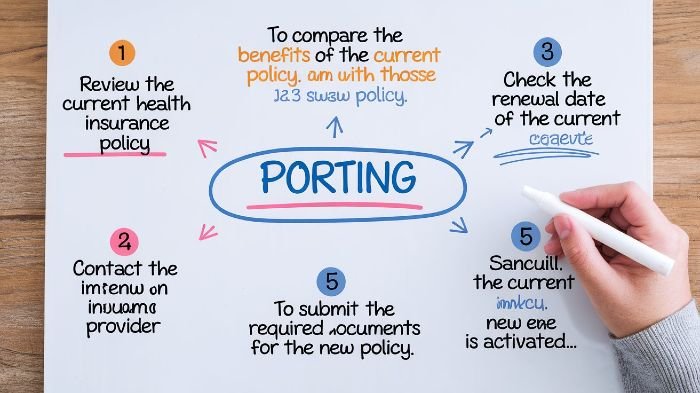
How to Port Your Health Insurance Policy: Step-by-Step
You are eligible. You know the benefits. Now, let’s get practical. Here is the exact process. Follow these steps. Do not skip any.
Step 1: Choose Your New Insurer
Do not rush this. This is the, at the top and most important, step. Your goal is a better policy. Do not just look at the price. A cheap policy may have terrible service. Or it may have concealed boundaries.
Research is your best friend. Read reviews online. Compare the features. What is the room rent limit? Is there a co-payment? Switching health insurance providers is a big decision. Make an informed one.
Know more about Understanding Riders in Life Insurance Plans and explore the Top 10 Health Insurance Plans for Families in 2025 for the best coverage. You can also read How to Calculate the Right Life Insurance Coverage for Your Family to make smart protection choices.
Step 2: The Application Window
Timing is everything. You have to apply at the right time. The rule is simple. You must apply not less than 45 days before your current policy expires.
Do not take 10 days before renewal. The new insurer will not have time. They must review your file. They have to contact your old insurer. This takes time. Applying 45 – 60 days in advance is perfect.
Step 3: Fill the Portability Form
The process of applying involves some paperwork (two forms). The first one is the Portability Form. This is a special form. It is used to tell the new insurance company that you want your port to be to.
It will ask for details. What is your most up-to-date policy number? Who is your current insurer? What is your sum insured? Be 100% accurate. Any mismatch will lead to delays.
Step 4: The Proposal Form
This is the main application. This is the proposal of your new policy. You have to be totally honest here. You will have to declare all your medical history.
Do not hide anything. Do not “forget” about surgery from 5 years ago. Insurers check. If they catch you in a lie, they will reject you. Honesty is the only policy. This is the part where most porting requests fail.
Step 5: Document Submission
Now, gather your papers. The new insurer needs proof. Give them copies of your old policy. Include the renewal notice. As you may have claims history, include them.
A clean, organized file helps. It makes life easier for the underwriter. An easier job by them, means decision by you faster.
Step 6: The Underwriting Process
This is the waiting period. The new insurer now looks over your file. This is called underwriting. They are determining whether you are a good risk.
They will contact your former insurance company. An IRDAI portal system is used by them. They will verify your claims. Your NCB will also be verified. They may require you for a medical check up. This is normal, and especially if you are older.
Step 7: Accepting the Offer
The new insurer has 15 days. They have to provide you with a decision in 15 days. If they do not, then they must accept your request. This is part of the IRDAI portability guidelines.
If they do accept, they send you an offer. This offer will specify the premium. It will include special conditions, if any. Review it carefully. If you agree, pay the premium. Do not allow your old policy to expire. Once you pay you are officially ported.
“The best time to shop paying for health insurance is not when you need it, but when you don’t. Portability gives you the power to shop every single year.” – Financial Advisor
Common Reasons Your Porting Request Might Be Rejected
Porting is your right. But the acceptance is not guaranteed. The new insurer has the right to refuse. They are taking on your risk. Let’s have a look then why they may reject you.
Bad Timing (Missing the Window)
This is the one very easily to avoid. You applied too late. You sent your forms in 15 days before renewal. The insurer does not have time.
They will deny the portability request. They may have a new policy available to you. But under a new policy you lose all your benefits. Always stick to the 45-day rule.
Incomplete Information
This is a frustrating reason. You forgot to sign a page. You left a section blank. Your documents were not clear to me.
The insurer will not chase after you. They will simply reject the application. Double-check everything. Triple-check it. Islay says you should make sure every form is perfect. This is an avoidable error.
Poor Claims History
This is a sensitive topic. Insurers are businesses. They manage risk. If you have made many large advances. They almost treat you as a high-risk customer.
They may be fearful you will cost them money. This is not discrimination. It is a business decision. You are not at the liberty to modify your claim history. But you must be aware of it.
High-Risk Profile
This is about your current health nowadays. You may have been affected by a new condition. Maybe you have been diagnosed with a serious illness.
The new insurer will see this. They may reject you. Or, they may offer you a policy. But they may not include this new condition. Or they might add “loading.” Loading means they are charging you a higher premium.
What to do if rejected?
Do not panic. You have one vital task. On the spot Renew your old Policy. Do not let it lapse. You can’t have a break in coverage. It is up to you to stay with your old provider. And you can try to port again next year.

Creative Section: Porting vs. Buying New
Is it ever better just to buy a new policy? Let’s compare.
| Feature | Porting Your Policy | Buying a New Policy |
| Waiting Periods | Credit for time served. (e.g., 1 year left) | Resets to zero. (e.g., 4 years left) |
| No-Claim Bonus | Protected and transferred. | Lost. You start from 0% NCB. |
| Pre-existing Illness | Covered after remaining wait. | Not covered for 3-4 years. |
| Process | Requires 45-day advance planning. | Can be done quickly, even last minute. |
| Best For | Anyone with an existing policy. | Young, healthy people buying for the first time. |
Key Considerations When Switching Insurers
You got approved! An offer was sent to you by your new insurer. Stop. Do not pay yet. The decision is not about simply price. You must check the fine print.
Switching health insurance providers is a serious move. The grass never is greener all the time. Assure yourself that you are going to a better policy.
Don’t Just Look at the Premium
A policy that is cheap is often cheap for a reason. It might have hidden traps. A low sum insured may be included. It might also have a “co-payment.”
A co-payment means that you pay a portion of every bill. For example, a 10% co-pay. If your bill is $1,000, you pay $100. The insurer pays $900. Avoid co-payments if you can.
Check the Network Hospitals
This is vital. Your policy is no good if you’re unable to use it. Take a look at the list of network hospitals. Is your favorite hospital on the list?
Do not just look at the sum total. An insurer proposing “10,000 hospitals” is useless… if there are none in your city. Check list for your particular area. This makes sure that you get the service of being cashless.
Read the New Policy Wording
This is the legal contract. It is boring. Read it anyway. Lay special attention on the “Exclusions” section. This is what the policy will not cover.
Does the new Policy have new exclusions? Or maybe in your old policy, you covered something. But the new one does not. You must know this. Port your health insurance policy only if the new contract is as good or better.
Room Rent Limits and Co-payments
This is where insurers entomb costs. Look for the room rent limit. Some policies contain limits to $50 a day room. If you take a $100 room, you pay.
And you do not simply pay the difference. The insurer may deduct the whole amount of the bill. Look for a policy of “No limit on room rent.” Or one that covers a “Single Private Room.”
“Reading your policy document is boring. Abstaining from reading it can be devastating.” – Consumer Rights Advocate
Know Your Rights
The insurance regulator, IRDAI, governs this whole process. They set the rules for all companies. It is wise to know your rights. You can read the official IRDAI portability guidelines on their website. This ensures you know what the insurer must do for you. Knowing the rules helps you navigate the process.
Challenges You Might Face During Portability
Let’s be honest. The process is not necessarily smooth. We want you to be prepared. Here are some common hurdles.
The Underwriting Hurdle
The new insurer will make a judgment about your health. This is the main filter. If you are young and healthy, it is not difficult. If you in older age will ask for medical test.
This test is covered by the insurance company. But the results are used for judging you. Be prepared for this step. Be cooperative. It is a way to show that you have nothing to hide.
Potential for Loading
What if your health is “okay”? Not bad, but not perfect. The insurance company may possibly “load” your premium.
Loading is a penalty. They increase your premium. They might charge you 15% or 25% more. This is because they identify you as being at a higher risk. This is still better than rejection. You get to port, but at a higher cost.
Losing Group Insurance Benefits
Many people attempt to port their group plan. This is the one that you have from your employer. This is often not allowed.
Group plans are different. They have different rules. They often cover it all the way from day one. A personal plan does not. Check your group plan to see if you can migrate to a personal plan. This is a different process.
How to Handle Differences in Coverage
This is a common question. What will happen if you upgrade your coverage? You want to port your health insurance policy, but also get more cover.
What if your sum insured changes?
Let’s say you have a $5,000 policy. You are wanting to port to new $10 000 policy. This is common. You want to make yourself more protected.
The insurer has a rule for this. They will port your $5,000. But the extra $5,000 is treated as new.
Handling new waiting periods for enhanced benefits
This is the key. Your old benefits are ported. The continuity benefits apply to your $5,000. Your waiting period for pre-existing diseases is waived for that amount.
But the additional $5,000 is different. You have to serve all the new waiting periods for that amount. This is fair. The insurer is assuming new risk. You get the best of both worlds. You save on your old benefits. And you add new ones.
Creative Section: Porting Scenario
Let’s look at an example which could be a real world scenario.
| Policyholder: | Mr. Verma |
| Old Policy | $5,000 Sum Insured |
| Time Served | 2 years (out of 4-year PED wait) |
| Action | Ports to a new $10,000 policy |
| The Result | |
| For the first $5,000: | He only has 2 years left on his PED wait. |
| For the extra $5,000: | He must serve the full 4-year PED wait. |
| His NCB: | Is fully transferred and applied. |
Research Your New Policy
Researching new insurers is nowhere near as challenging. You do not need to call up everyone. You can take financial comparison websites. Sites like Policybazaar (for India) or Insurify (for the US) let you compare plans. (Note: These are examples of external links.) They show you features side-by-side. This helps you make a smart choice. You can find the best policy for your needs. Always double-check the details on the insurer’s official website.
“Your health is your most valuable asset. Your health insurance is the contract that protects it. Review that contract. Choose it wisely.”
Conclusion: Porting Smartly is Your Right
You are now ready. The necessary knowledge is with you. You know how to port your health insurance policy without losing your benefits. The fear is gone. It is replaced with a clear plan.
Remember the key lessons. Start 45 days early. Be 100% honest on your forms. Read the new policy’s fine print. Check the network hospitals.
Portability is your right. It keeps insurers competitive. It gives you freedom of choice. You deserve a provider that offers good service. If your current insurer is not, you know what to do. Use this guide. Protect your benefits. And move to a better, more secure future.

Find out Term Insurance vs Whole Life Insurance — Which One Suits You Best? and Why Millennials Should Consider Life Insurance Early. Don’t miss the Best Life Insurance Companies with High Claim Settlement Ratio 2025 and learn How to File a Car Insurance Claim Step-by-Step for smooth claim handling.
Frequently Asked Questions (FAQs)
Yes. They can apply a “loading” fee. This happens if they consider you a high-risk individual. But they cannot charge you more just because you ported.
You get the benefit of the lesser waiting period. If you served 2 years of a 4-year wait… and the new policy only has a 3-year wait… you only have 1 year left.
No. Your new insurer handles all communication. They will contact your old insurer through the IRDAI portal. You just need to pay your old insurer if your porting is rejected.
Yes. You can port the entire policy. All members will be ported. The continuity benefits will apply to all members.
Yes, you can. This is called a downgrade. Your continuity benefits will still apply. This is a good option if you feel you are over-insured.