Urdu & Arabic Calligraphy
Tools & Generators

Professional-grade free tools for Urdu text styling, calligraphy font preview, Nastaliq generator, and more. No signup needed.

Explore Free Tools ↓
Urdu calligraphy tools illustration showing a quill pen with Arabic letters and gold decorative elements
Nastaliq • Naskh • 4 Authentic Fonts
Advertisement

Free Calligraphy Tools

All tools run in your browser — no data is sent to any server.

🖋️ Urdu / Arabic Calligraphy Text Generator

Most Popular

Type any Urdu or Arabic text and instantly preview it in multiple calligraphy styles. Copy or download as image. Open as full page →

60px

🔤 Calligraphy Font Comparator

Compare how your text looks in different Urdu and Arabic fonts side by side. Open as full page →

🔢 Urdu Unicode Inspector

Paste any Urdu or Arabic text to see its Unicode codepoints, character names, and encoding details. Useful for developers and designers. Open as full page →

🎴 Calligraphy Name Card Generator

New

Generate a beautiful name card in calligraphy style. Perfect for invitations, social profiles, and gifts. Open as full page →

✂️ Urdu Harakat / Diacritic Remover

Remove all diacritical marks (zabar, zer, pesh, shadda, etc.) from Urdu or Arabic text in one click. Open as full page →

↔️ RTL / LTR Text Fixer

Fix broken Urdu/Arabic text direction when copied from PDFs or emails. Also counts words, characters, and lines. Open as full page →

🔢 Urdu Number-to-Words Converter

New

Convert any number into written Urdu words — useful for cheques, legal documents, invitations, and invoices. Open as full page →

🧩 Which Calligraphy Style Is This?

New

Test your eye for calligraphy styles. We'll show you a sample rendered in one of our fonts — guess whether it's Nastaliq or Naskh.

🌙 Hijri ↔ Gregorian Date Converter

New

Convert any date between the Islamic (Hijri) calendar and the Gregorian calendar, with Hijri month names shown in Urdu. Open as full page →

Note: this uses the standard calculated (tabular) Islamic calendar. Locally observed Hijri dates can differ by a day depending on regional moon sighting.

📖 Urdu Alphabet & Letter Forms Explorer

New

Browse all Urdu letters with their isolated form, an example word, pronunciation notes, and Unicode codepoint. Open as full page →

📜 Urdu Proverbs in Calligraphy

New

A small gallery of traditional Urdu proverbs (ضرب الامثال), rendered in calligraphy with their meaning explained.

Advertisement

What is Urdu Calligraphy?

Urdu calligraphy (خطاطی, khattati) is one of the most revered art forms in South Asian and Islamic culture. Rooted in Arabic script and refined over centuries by Persian and Indian masters, Urdu calligraphy is not merely handwriting — it is a visual poetry where every curve, every dot, and every stroke carries meaning.

Major Calligraphy Styles
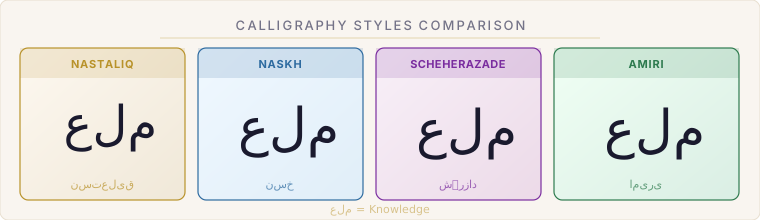
Four calligraphy styles comparison: Nastaliq, Naskh, Scheherazade and Amiri each showing the Urdu word for knowledge
نستعلیق

Nastaliq (نستعلیق)

The most popular style for Urdu. Its hanging, right-to-left diagonal flow gives it an elegant, flowing character. Used in books, poetry, and signage throughout Pakistan and India.

نسخ

Naskh (نسخ)

Clear and readable, Naskh is the standard script for print and digital Arabic. Its balanced proportions make it ideal for long-form text, newspapers, and holy texts like the Quran.

ثلث

Thuluth (ثلث)

Meaning "one third," Thuluth is a grand, monumental script used for mosque decorations, titles, and headings. Its elongated letters and sweeping curves convey power and majesty. Note: we don't yet offer a true Thuluth web font in our generator — the word above is shown in Amiri for reference only.

دیوانی

Diwani (دیوانی)

Developed in the Ottoman court, Diwani is highly ornamental with elaborate loops and strokes. It was historically used for royal decrees and official Ottoman documents. Note: an authentic Diwani font isn't currently in our toolkit — the word above is shown in Scheherazade New for reference only.

Our Calligraphy Generator and Font Comparator currently support Nastaliq and Naskh-family fonts (Noto Nastaliq Urdu, Noto Naskh Arabic, Scheherazade New, Amiri). Thuluth and Diwani are described above for educational reference, but we don't yet have a properly licensed, high-quality web font for either style — adding one is on our roadmap.

How to Use Our Tools

  1. Calligraphy Generator: Type or paste any Urdu/Arabic text, choose a font style, pick your colors, and download a high-quality PNG image instantly.
  2. Font Comparator: Enter any phrase and see how it looks in all major Urdu and Arabic calligraphy fonts side by side — perfect for designers choosing a font.
  3. Unicode Inspector: Developers and typographers can paste any text to see its exact Unicode codepoints, which is essential for proper font rendering and text processing.
  4. Name Card Generator: Create a personalized calligraphy name card for weddings, invitations, social media, or personal branding in seconds.
  5. Diacritic Remover: Paste any text with harakat (vowel marks) and remove them all instantly — useful for creating cleaner text versions.
  6. Number-to-Words Converter: Turn any number into written Urdu words using the lakh/crore system — handy for cheques, invoices, and legal documents.
  7. Hijri Date Converter: Convert any date between the Gregorian and Islamic calendars in either direction, with month names shown in Urdu.
  8. Alphabet Explorer: Browse every Urdu letter with an example word, pronunciation note, and Unicode codepoint — useful for learners and developers alike.

Frequently Asked Questions

Our generator supports four major typefaces: Noto Nastaliq Urdu (the standard Nastaliq), Noto Naskh Arabic, Scheherazade New, and Amiri. All are high-quality, Unicode-compliant Google Fonts that render accurately on all devices.
The tools themselves are free to use. The fonts used (Noto, Amiri, Scheherazade) are published under the SIL Open Font License (OFL), which permits commercial use. Always check the specific font's license for your use case.
No. All tools on UrduCraft run entirely in your browser using JavaScript and the HTML5 Canvas API. Your text never leaves your device.
Urdu uses a modified Perso-Arabic alphabet with some additional letters not found in Arabic, such as ٹ (ṭe), ڈ (ḍal), ڑ (ṛe), and ں (noon ghunna). While both scripts are right-to-left and share most characters, Urdu is almost exclusively written in Nastaliq style, whereas Arabic more commonly uses Naskh in print.
Broken Urdu text usually happens due to missing RTL (right-to-left) support or incorrect Unicode encoding. Use our RTL/LTR Text Fixer tool to diagnose and correct direction issues. Also ensure the app or font you're using has full Unicode Urdu support.
These tools are designed for calligraphers and artists wanting digital previews, graphic designers working with Urdu/Arabic typography, developers needing Unicode information, students learning Urdu script, and anyone creating wedding invitations, social media posts, or gifts with Urdu text.
Our converter uses the standard calculated (tabular) Islamic calendar, which approximates the lunar cycle mathematically rather than relying on moon sighting. This is reliable for general reference, but the actual locally observed Hijri date — especially the start of Ramadan or Eid — can differ by a day depending on your region's moon-sighting announcements. For religious observance, always confirm with your local mosque or official authority.
These are traditional Urdu folk proverbs (ضرب الامثال) that have been passed down through generations and are not attributed to any single author — similar to how English proverbs like "the early bird catches the worm" belong to the language itself rather than to a copyrighted source.