Learn Urdu & Arabic Calligraphy
A practical guide to the history, tools, and techniques behind one of the world's most expressive art forms.
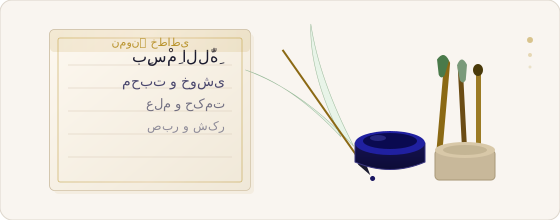
A Brief History
Arabic-script calligraphy emerged in the 7th century alongside the spread of Islam, initially as a way to faithfully and beautifully transcribe the Quran. Over the following centuries, regional schools developed distinct styles: Kufic in Iraq, Naskh across the wider Arab world, and eventually Nastaliq in Persia, which was later adopted as the primary script for Urdu poetry and literature in South Asia during the Mughal era.
By the 18th and 19th centuries, Nastaliq had become so closely associated with Urdu that nearly all Urdu newspapers, books, and signage used it almost exclusively, a tradition that continues today, even as digital typography has introduced more flexibility.
Traditional Tools of the Calligrapher
Qalam (قلم)
A reed pen, traditionally cut and shaped by the calligrapher themselves. The angle and width of the cut nib determines the thickness and style of strokes.
Khat-kash (خط کش)
A ruling tool used to draw guide lines, ensuring consistent letter height and baseline across a composition.
Siyah (سیاہ)
Traditional ink, often handmade from soot, gum arabic, and water, prized for its rich black tone and smooth flow.
Aabi Kaghaz
Specially treated and burnished paper that prevents ink from bleeding and gives a smooth surface for fine strokes.
Letter Forms: A Beginner's Note
Unlike the Latin alphabet, Arabic-script letters change shape depending on their position in a word: initial, medial, final, or isolated. For example, the letter ع (ain) looks markedly different at the start of a word versus at the end. This is one reason digital Urdu typesetting historically lagged behind Latin scripts: each letter requires multiple contextual glyph variants to render correctly.
Modern fonts like Noto Nastaliq Urdu solve this using OpenType contextual substitution, automatically selecting the correct glyph shape based on a letter's position, the same technology our Calligraphy Generator relies on.
Tips for Beginners
- Start with Naskh, not Nastaliq. Naskh's more upright, regular letterforms are easier to learn before attempting Nastaliq's diagonal flow.
- Practice the baseline first. Most beginners focus on individual letters before mastering how letters sit on and below the baseline, which is actually the harder skill.
- Study proportion, not just shape. Traditional calligraphy uses a dot (نقطہ) as a unit of measurement; letter heights and widths are defined in multiples of this dot.
- Use digital tools to plan, not replace, practice. Our font comparator and generator are great for previewing how a phrase will look, but nothing replaces physical practice with a qalam for those learning the traditional art.
Try It Yourself
Head back to our tools page to experiment with different calligraphy styles using your own text.
Regional Variations Worth Knowing
Calligraphy traditions are not uniform across the regions that use Arabic script. Persian calligraphers historically developed their own refinements to Nastaliq, sometimes called "Iranian Nastaliq," with subtly different proportions than the version that became standard for Urdu in South Asia. Ottoman calligraphers, meanwhile, developed entirely distinct decorative traditions like Diwani and Tughra (the latter used for sultans' monogram-like signatures), which never became part of everyday Urdu typesetting but remain historically significant and visually striking. If you're researching calligraphy for a specific cultural context (Persian poetry, Ottoman architecture, South Asian Urdu literature), it's worth confirming which regional tradition's conventions actually apply, since "Arabic calligraphy" as a single category can be misleading.
Digital Calligraphy vs. Hand-Drawn Calligraphy
It's worth being direct about what digital tools, including the ones on this site, can and cannot do. A well-engineered font like Noto Nastaliq Urdu captures the structural rules of the script extremely well: correct letter joining, accurate contextual forms, faithful proportions. What it cannot replicate is the organic variation a skilled calligrapher introduces by hand: the slight pressure changes from a reed pen, the deliberate irregularities that give hand-lettered work its character, or the ability to adjust a composition's spacing and flow to fit an unusual layout. Digital tools are excellent for speed, consistency, and previewing. They are not a replacement for commissioned hand calligraphy when that level of craft is what a project calls for.
A Short Glossary
Go Deeper
If any of the topics above interest you further, we've written longer pieces on several of them:
- The four contextual forms every letter can take, with specific examples
- How kashida elongation actually works, and where designers commonly misuse it
- A practical path for learning to read decorative calligraphy if you already read standard printed Urdu
- How Persian, Pashto, and Sindhi adapted the same script differently from Urdu