How the Hijri Calendar Works: A Practical Guide
Reference • 6 min read
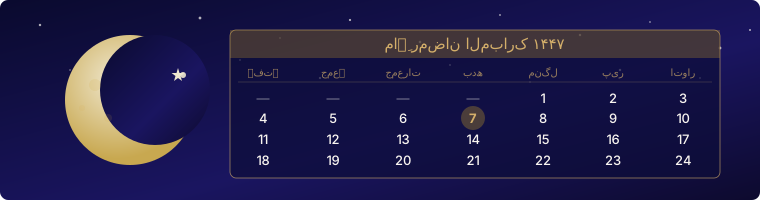
Ramadan and Eid land on a different Gregorian date every single year — sometimes shifting by ten or eleven days compared to the year before. That drift isn't random; it comes directly from how the Hijri calendar is structured, which follows an entirely different astronomical basis than the calendar most of the world uses for civil dates.
A Lunar Calendar, Not a Solar One
The Gregorian calendar is solar — it's built around the time it takes Earth to orbit the sun, roughly 365.25 days, which is why a leap day is added every four years to keep it aligned. The Hijri calendar, by contrast, is purely lunar, built around the time it takes the moon to complete a full cycle of phases, approximately 29.5 days. Twelve of these lunar months add up to roughly 354 days — about 10 to 12 days shorter than a solar year. This is the entire reason Hijri dates drift earlier relative to the Gregorian calendar year after year, completing a full cycle through all four seasons roughly every 33 Gregorian years.
The Twelve Hijri Months
The Hijri year consists of twelve months: Muharram, Safar, Rabi al-Awwal, Rabi al-Thani, Jumada al-Awwal, Jumada al-Thani, Rajab, Shaban, Ramadan, Shawwal, Dhul Qadah, and Dhul Hijjah. Several carry particular religious significance — Ramadan as the month of fasting, and Dhul Hijjah as the month of Hajj. Each month, traditionally, begins with the sighting of a new crescent moon, which is why the exact start date of any given Hijri month can vary slightly by region depending on local moon-sighting committees and weather conditions affecting visibility.
Calculated vs. Observed Dates
This is the detail that trips up most date-conversion tools, including ours. There are two distinct ways a Hijri date gets determined. The first is observation-based: a local moon-sighting committee, or a country's religious authority, declares a new month has begun once the crescent moon is physically sighted (or, in some countries, based on astronomical calculation of when sighting would theoretically be possible). The second is a tabular or "calculated" calendar — a fixed mathematical rule that alternates 30-day and 29-day months in a predictable pattern across a 30-year cycle, designed to approximate the average lunar cycle without requiring observation at all.
Our Hijri Date Converter uses this second, calculated approach — the same method historically used in administrative and civil contexts where a predictable, calendar-printable date system is more useful than waiting for a monthly sighting announcement. The tradeoff is that a calculated date can differ from the locally observed date by a day, occasionally two, particularly for the start of Ramadan and Eid, when many countries rely on actual sighting reports rather than calculation.
Why This Matters Practically
If you're using a Hijri date for a general reference — labeling an old document, estimating roughly which Hijri year a Gregorian date falls in, or adding a calligraphy-style date to a design — a calculated conversion is perfectly adequate. If you need the exact, officially observed date for a religious obligation (the start of fasting, the date of Eid prayers, the day of Hajj), you should always confirm with your local mosque, religious authority, or your country's official moon-sighting announcement rather than relying solely on any calculated converter, including this one.
The Epoch: Where Year 1 Begins
The Hijri calendar's year 1 corresponds to the year of the Hijra — the migration of the Prophet Muhammad from Mecca to Medina, traditionally dated to 622 CE in the Gregorian calendar. This is why you'll often see Hijri years written with the suffix "AH" (Anno Hegirae, "in the year of the Hijra"), parallel to how Gregorian years use "AD" or "CE."
Try a Conversion
You can convert any date in either direction using our Hijri ↔ Gregorian Date Converter — useful for quickly estimating historical dates, labeling designs, or just satisfying curiosity about which Hijri year corresponds to a given Gregorian date.